
Sciatica · Warrington
Sciatica treatment in Warrington — expert care for sciatic nerve pain
If you're finding it difficult to:
- Get through the day without shooting pain down your leg
- Sit comfortably without symptoms flaring
- Sleep without sciatic nerve pain waking you
You’re not alone — and you don’t have to just put up with it. Sciatica refers to pain that travels from the lower back down the leg, caused by irritation of the sciatic nerve — the largest nerve in the body. It runs from the lower spine through the buttock and down the back of the leg to the foot.
Good News
The good news
Most cases of sciatica improve significantly with the right physiotherapy treatment — without injections or surgery. Movement, exercise and targeted rehabilitation can reduce nerve irritation and restore normal movement. Many of our patients go from barely being able to walk to back to full activity within weeks.
Symptoms
Does this sound like you?
Pain travelling from the lower back into the buttock and leg
Sharp, burning or shooting pain down the back of the leg
Tingling or pins and needles in the leg or foot
Numbness in the leg, calf or foot
Weakness in the leg or foot
Pain that worsens with sitting, bending or first thing in the morning
If any of these sound familiar, a physiotherapy assessment will tell you exactly what’s happening — and what will help.
Why it persists
Why does sciatica become a long-term problem?
Sciatica persists when the underlying cause isn’t properly identified and addressed. Most people are told to rest, which reduces pain temporarily but doesn’t treat the nerve irritation at source. In many cases, the sciatic nerve is being aggravated by a disc bulge, joint inflammation, or muscle tightness in the buttock (piriformis) — each requiring a different treatment approach. Without knowing which, you’re guessing.
Who gets sciatica?
- Adults aged 30–60
- People with physically demanding jobs
- Individuals who sit for long periods
- People who perform heavy lifting
- Those with previous back problems
Common causes
- A disc bulge or herniation pressing on the nerve root
- Inflammation around the sciatic nerve in the lower back
- Muscle tightness in the buttock (piriformis syndrome)
- Reduced spinal mobility
- Prolonged sitting or poor posture
- Heavy lifting or sudden twisting movements
Self-help
Simple steps that may help
01
Stay active and avoid prolonged bed rest — movement helps
02
Take regular breaks from sitting
03
Perform gentle back mobility exercises
04
Walk regularly to keep the spine moving
If symptoms persist beyond 2–3 weeks, physiotherapy assessment is recommended.
When to seek help
When should you get help?
- Pain lasting more than 2–3 weeks
- Leg pain that is worsening
- Walking or sitting becomes difficult
- Symptoms affecting work or sleep
Early treatment = faster recovery. Most patients start to notice improvement within the first few sessions.
Red flags
Red flag symptoms
- Pain lasting more than 2–3 weeks
- Leg pain that is worsening
- Walking or sitting becomes difficult
- Symptoms affecting work or sleep
These symptoms may indicate cauda equina syndrome and require URGENT medical attention — call 999 or go to A&E.
Treatment
How we treat Sciatica
At our clinic in Stockton Heath, Warrington, we use evidence-based treatments tailored to your specific condition
Hands-on physiotherapy
Spinal mobilisation, soft tissue work and nerve mobilisation techniques
Stimpod nerve stimulation
Effective for persistent sciatic nerve irritation
EMTT
For deep tissue recovery in chronic or disc-related sciatica
Rehabilitation exercises
Strengthening the core and back to reduce nerve compression
Posture & movement advice
Identifying and correcting the habits driving the problem
Start fixing your sciatica today
If your symptoms have lasted more than 2–3 weeks, they’re unlikely to go away on their own. The sooner you start treatment, the faster you recover.
Full appointment
Full Physiotherapy Assessment
A detailed diagnosis and a personalised treatment plan, ready to start straight away.
Free, no obligation
Free 15-Minute Discovery Visit
A quick chat to understand your problem, answer your questions and point you in the right direction. No obligation.
or call 01925 266881 · Monday–Saturday · No GP referral needed
Ready to get this sorted? No GP referral needed.
Free Guide
Not ready to book yet?
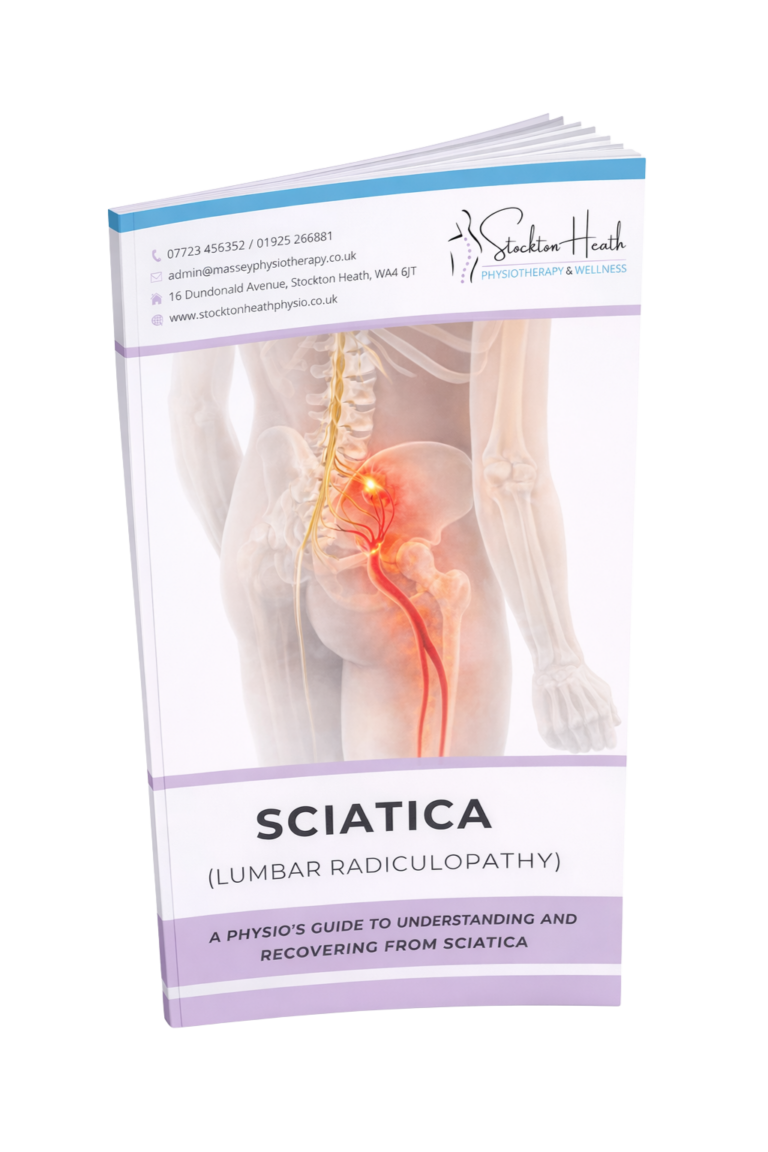
Want to start understanding and improving at home before you commit to an appointment? Download our free guide
Download your free guide
No spam, ever. Unsubscribe anytime.