
Struggling with hip arthritis in Warrington?
Hip arthritis treatment in Warrington — stay active without surgery
If you're finding it difficult to:
- Walk comfortably without groin or hip pain
- Get out of chairs and cars without stiffness stopping you
- Stay active and independent — without a hip replacement being the immediate answer
You’re not alone — and you don’t have to just put up with it. Hip osteoarthritis occurs when the cartilage lining the hip joint gradually becomes thinner and less smooth. This leads to pain — typically felt in the groin, front of the thigh or buttock — along with stiffness and reduced range of movement. It develops gradually and tends to affect adults over 50, though it can occur earlier after previous hip injuries.
Good News
The good news
Many people with hip arthritis can significantly improve their symptoms with physiotherapy and exercise — without surgery. Strengthening the muscles around the hip supports the joint, reduces load through the cartilage, and improves movement. EMTT is available at our clinic and is showing promising results for hip OA management alongside structured rehabilitation.
Symptoms
Does this sound like you?
Deep groin pain or aching when walking or standing
Stiffness in the hip — particularly in the morning or after sitting
Difficulty putting on socks, shoes or tying laces
Reduced range of hip movement when rotating the leg
A grinding or catching sensation in the hip joint
Pain that eases a little with gentle movement but worsens with sustained activity
If any of these sound familiar, a physiotherapy assessment will tell you exactly what’s happening — and what will help.
Why it persists
Why does hip arthritis (OA) become a long-term problem?
Hip arthritis that keeps worsening is often being managed with pain relief alone — without the structured exercise that actually makes a difference to joint health. The evidence is clear that progressive strengthening of the hip muscles is the most effective intervention for hip OA. Without it, the joint is carrying load it doesn’t need to.
Who gets hip arthritis (OA)?
- Adults aged 50 and over
- People with previous hip injuries or fractures
- Those with a family history of arthritis
- People with physically demanding occupational histories
- Those with higher body weight
Common causes
- Age-related changes in joint cartilage
- Previous hip injuries
- Muscle weakness around the hip
- Reduced joint mobility increasing load through the cartilage
- Excess body weight
- Genetic factors
Self-help
Simple steps that may help
01
Stay active with low-impact exercise — walking and cycling
02
Perform hip and leg strengthening exercises
03
Avoid prolonged inactivity — the joint needs movement
04
Maintain supportive footwear
If symptoms persist beyond 2–3 weeks, physiotherapy assessment is recommended.
When to seek help
When should you get help?
- Hip pain lasting more than 2–3 weeks
- Stiffness affecting daily activities
- Walking or stairs becoming increasingly difficult
- Symptoms gradually worsening
Early treatment = faster recovery. Most patients start to notice improvement within the first few sessions.
Red flags
Red flag symptoms
- Severe hip pain following a fall or injury
- Sudden inability to bear weight
- Significant swelling in the joint
- Severe night pain or unexplained weight loss
These symptoms require GP review to exclude other causes.
Treatment
How we treat hip arthritis (OA) at SHPW
At our clinic in Stockton Heath, Warrington, we use evidence-based treatments tailored to your specific condition
Hands-on physiotherapy
Manual therapy and targeted hip mobility work
EMTT
For hip osteoarthritis management and pain reduction
Progressive strength programme
Hip, gluteal and leg strengthening to reduce joint load
Gait and movement coaching
Identifying and correcting loading patterns
Orthotics
Where foot and ankle mechanics are contributing to hip load
Start fixing your hip arthritis today
If your symptoms have lasted more than 2–3 weeks, they’re unlikely to go away on their own. The sooner you start treatment, the faster you recover.
Full appointment
Full Physiotherapy Assessment
A detailed diagnosis and a personalised treatment plan, ready to start straight away.
Free, no obligation
Free 15-Minute Discovery Visit
A quick chat to understand your problem, answer your questions and point you in the right direction. No obligation.
or call 01925 266881 · Monday–Saturday · No GP referral needed
Ready to get this sorted? No GP referral needed.
Free Guide
Not ready to book yet?
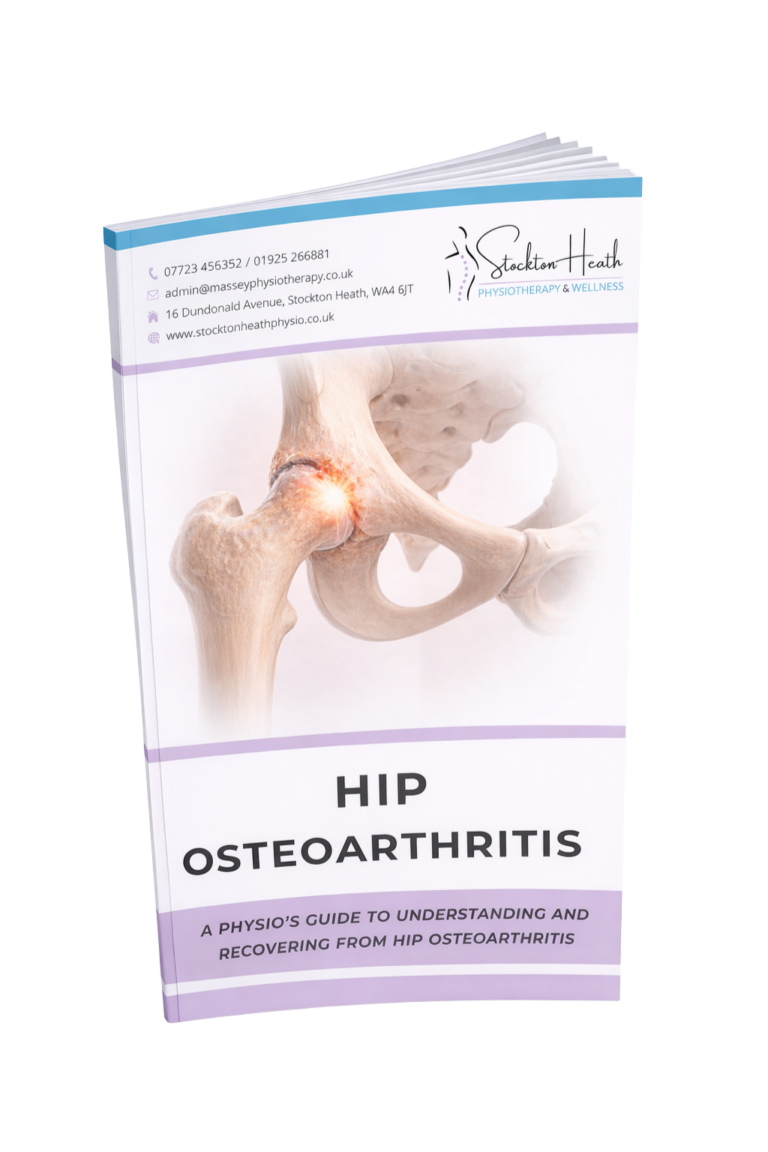
Want to start understanding and improving at home before you commit to an appointment? Download our free guide
Download your free guide
No spam, ever. Unsubscribe anytime.