
Struggling with knee pain from a meniscus injury in Warrington?
Meniscus injury treatment in Warrington — many cases resolve without surgery
If you're finding it difficult to:
- Walk and move without the knee swelling or giving way
- Return to sport or active life
- Get a clear diagnosis — not just “rest and see”
You’re not alone — and you don’t have to just put up with it. The meniscus is a piece of cartilage inside the knee that acts as a shock absorber between the thigh and shin bones. Each knee has two menisci. When this cartilage becomes torn or irritated — either through a sudden twisting injury or gradual wear — it can cause pain, swelling and difficulty moving the knee.
Good News
The good news
Many meniscal injuries — including partial tears — improve significantly with physiotherapy and rehabilitation without surgery. Research increasingly shows that for most patients, structured rehabilitation produces outcomes comparable to surgery, without the recovery time. The key is accurate diagnosis to understand the type and location of the injury.
Symptoms
Does this sound like you?
Pain in the knee joint — often on the inner or outer line
Pain when twisting, squatting or pivoting
Swelling in the knee — often within 24 hours of injury
Difficulty fully bending or straightening the knee
A clicking, catching or clunking sensation
A feeling the knee may lock or give way
If any of these sound familiar, a physiotherapy assessment will tell you exactly what’s happening — and what will help.
Why it persists
Why does meniscus injury become a long-term problem?
Meniscal injuries that don’t improve are usually cases where the muscle support around the knee hasn’t been rebuilt after the initial injury. The meniscus depends on the surrounding muscles to reduce the load it absorbs. Without strengthening the quadriceps, hamstrings and glutes, the cartilage continues to be overloaded and the symptoms persist.
Who gets meniscus injury?
- Sport participants who twist or pivot
- Adults aged 30–60
- People with previous knee injuries
- Older adults where cartilage degrades with age
- Those returning to activity after a break
Common causes
- Sudden twisting movements during sport
- Deep squatting or kneeling
- Degenerative changes in the cartilage with age
- Previous knee injuries
- Weak muscles around the knee failing to protect the joint
- Landing awkwardly from height
Self-help
Simple steps that may help
01
Rest from aggravating activities initially
02
Apply ice if the knee is swollen
03
Avoid deep squatting or twisting
04
Begin gentle strengthening as the initial inflammation settles
If symptoms persist beyond 2–3 weeks, physiotherapy assessment is recommended.
When to seek help
When should you get help?
- Knee pain lasting more than 2–3 weeks
- Swelling that keeps returning
- The knee feeling unstable or weak
- Walking or stairs becoming difficult
Early treatment = faster recovery. Most patients start to notice improvement within the first few sessions.
Red flags
Red flag symptoms
- Severe knee pain after injury
- The knee becoming locked and unable to straighten
- Significant swelling after a fall or twisting injury
- Inability to bear weight on the leg
These symptoms may require GP review or imaging to assess the extent of injury.
Treatment
How we treat meniscus injury at SHPW
At our clinic in Stockton Heath, Warrington, we use evidence-based treatments tailored to your specific condition
Physiotherapy assessment
Hands-on diagnosis and targeted treatment
Rehabilitation programme
Progressive quadriceps, hamstring and gluteal strengthening
EMTT
For cartilage recovery support and pain reduction
Movement and gait coaching
Restoring safe loading patterns
Shockwave therapy
For associated tendon irritation around the knee
Start fixing your meniscus injury today
If your symptoms have lasted more than 2–3 weeks, they’re unlikely to go away on their own. The sooner you start treatment, the faster you recover.
Full appointment
Full Physiotherapy Assessment
A detailed diagnosis and a personalised treatment plan, ready to start straight away.
Free, no obligation
Free 15-Minute Discovery Visit
A quick chat to understand your problem, answer your questions and point you in the right direction. No obligation.
or call 01925 266881 · Monday–Saturday · No GP referral needed
Ready to get this sorted? No GP referral needed.
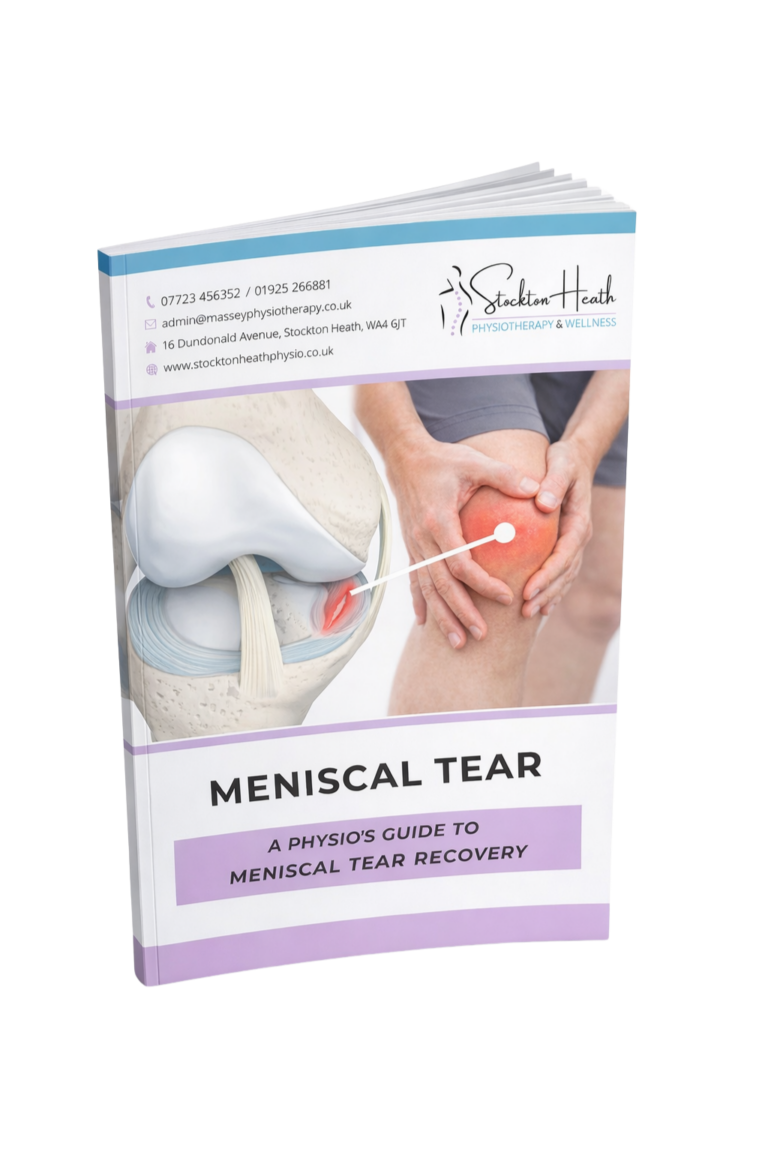
Free Guide
Not ready to book yet?
Want to start understanding and improving at home before you commit to an appointment? Download our free guide
Download your free guide
No spam, ever. Unsubscribe anytime.