
Struggling with pain around your kneecap in Warrington?
Runner’s knee (PFPS) treatment in Warrington — back to running pain-free
If you're finding it difficult to:
- Run without pain building around the kneecap
- Climb stairs without the front of the knee aching
- Get back to training without the knee holding you back
You’re not alone — and you don’t have to just put up with it. Runner’s knee — medically known as patellofemoral pain syndrome (PFPS) — is pain at the front of the knee around or behind the kneecap. It occurs when the kneecap doesn’t track correctly during movement, creating friction and irritation between the kneecap and the groove it sits in.
Good News
The good news
Runner’s knee responds very well to physiotherapy — most runners return to pain-free running within weeks. The condition is driven by specific, identifiable movement and strength deficits that respond well to targeted rehabilitation. Shockwave therapy is available at our clinic for cases where tendon involvement is also present.
Symptoms
Does this sound like you?
Pain around or behind the kneecap — during or after running
Pain when climbing or descending stairs
Pain when squatting or lunging
A dull ache after prolonged sitting with the knee bent (cinema sign)
Pain that builds during a run and gets worse towards the end
Occasional knee swelling after activity
If any of these sound familiar, a physiotherapy assessment will tell you exactly what’s happening — and what will help.
Why it persists
Why does runner’s knee (PFPS) become a long-term problem?
Runner’s knee that doesn’t resolve is almost always because the underlying cause hasn’t been identified. The kneecap is tracking poorly because the muscles controlling it — typically the VMO, glutes and hip abductors — aren’t doing their job properly. Generic quad strengthening without addressing hip and glute weakness rarely fixes it long-term.
Who gets runner’s knee (PFPS)?
- Runners and active individuals
- People who do a lot of stairs or squats
- Those who have rapidly increased their training volume
- Individuals with weak hip or gluteal muscles
- Young active adults
Common causes
- Weak VMO (inner quad) causing the kneecap to track laterally
- Weak glutes and hip abductors causing the knee to collapse inward when running
- Sudden increase in training volume or intensity
- Poor running mechanics
- Tight IT band or lateral structures pulling the kneecap off track
Self-help
Simple steps that may help
01
Temporarily reduce running volume
02
Avoid exercises that specifically provoke the pain (deep squats, stairs)
03
Apply ice after activity
04
Begin hip strengthening exercises — glutes and hip abductors
If symptoms persist beyond 2–3 weeks, physiotherapy assessment is recommended.
When to seek help
When should you get help?
- Pain lasting more than 2–3 weeks
- Pain worsening with continued training
- Running becoming difficult
- Symptoms affecting non-running daily life
Early treatment = faster recovery. Most patients start to notice improvement within the first few sessions.
Red flags
Red flag symptoms
- Severe knee pain after injury
- Significant swelling in the knee
- A popping sensation during activity
- Sudden inability to straighten the knee
These symptoms may require GP review or imaging.
Treatment
How we treat runner’s knee (PFPS) at SHPW
At our clinic in Stockton Heath, Warrington, we use evidence-based treatments tailored to your specific condition
Physiotherapy assessment
Kneecap tracking analysis and gait assessment
Hip and gluteal rehabilitation programme
The key driver of PFPS recovery
Running technique coaching
Identifying and correcting the mechanics causing overload
Shockwave therapy
For cases with associated patellar tendon involvement
Load management advice
Structured return-to-running programme
Start fixing your runner’s knee today
If your symptoms have lasted more than 2–3 weeks, they’re unlikely to go away on their own. The sooner you start treatment, the faster you recover.
Full appointment
Full Physiotherapy Assessment
A detailed diagnosis and a personalised treatment plan, ready to start straight away.
Free, no obligation
Free 15-Minute Discovery Visit
A quick chat to understand your problem, answer your questions and point you in the right direction. No obligation.
or call 01925 266881 · Monday–Saturday · No GP referral needed
Ready to get this sorted? No GP referral needed.
Free Guide
Not ready to book yet?
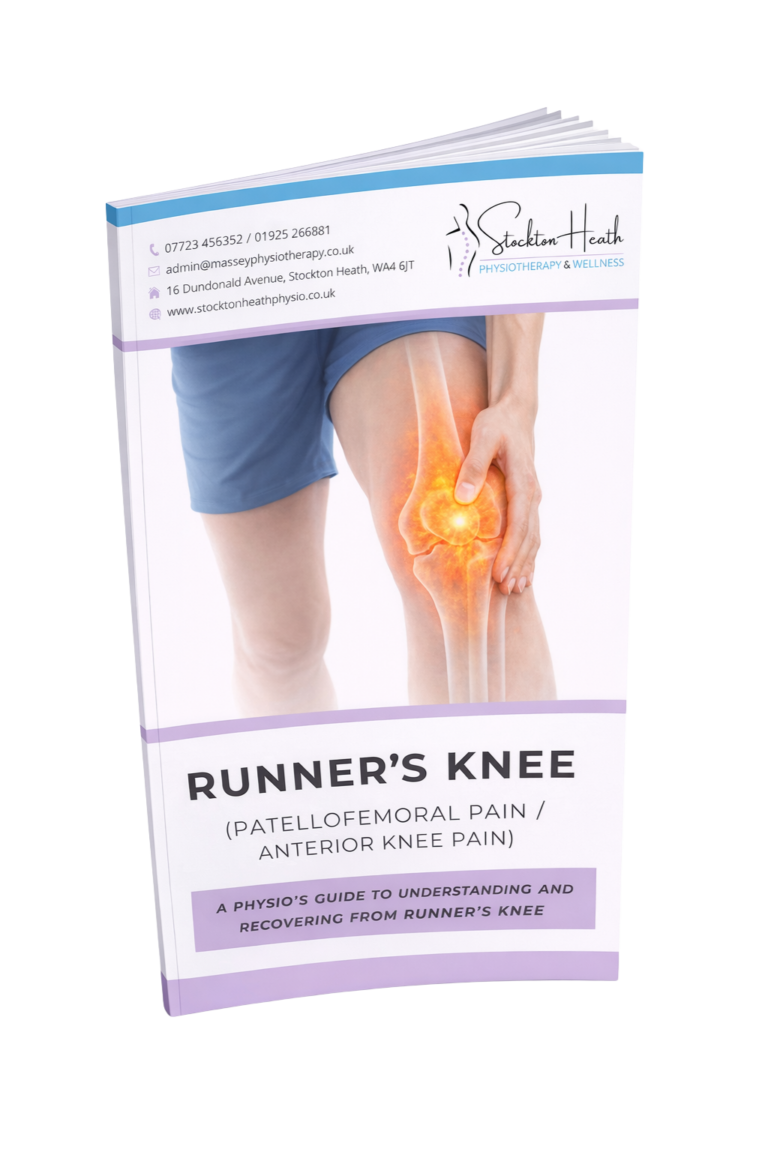
Want to start understanding and improving at home before you commit to an appointment? Download our free guide
Download your free guide
No spam, ever. Unsubscribe anytime.