
Struggling with an ankle sprain in Warrington?
Ankle sprain treatment in Warrington — proper rehab prevents lasting instability
If you're finding it difficult to:
- Walk and move without the ankle feeling weak or unstable
- Return to sport or activity with confidence
- Stop repeated ankle sprains that keep setting you back
You’re not alone — and you don’t have to just put up with it. An ankle sprain occurs when the ligaments supporting the ankle are stretched or partially torn, usually after the foot rolls or twists suddenly. It’s one of the most common musculoskeletal injuries — and one of the most undertreated. Without proper rehabilitation, the ankle never fully recovers its stability, leading to repeated sprains.
Good News
The good news
Most ankle sprains recover fully with the right rehabilitation. The key is not just letting the swelling settle but properly rebuilding the strength, proprioception and coordination the ankle needs to perform reliably again. Early, appropriate treatment significantly reduces the risk of long-term instability.
Symptoms
Does this sound like you?
Pain around the ankle joint immediately after injury
Swelling — often appearing rapidly
Bruising around the ankle and foot
Difficulty walking or bearing weight
Tenderness when pressing on the injured ligaments
A feeling the ankle is weak or might give way
If any of these sound familiar, a physiotherapy assessment will tell you exactly what’s happening — and what will help.
Why it persists
Why does ankle sprain become a long-term problem?
Ankle problems that persist after a sprain are almost always the result of incomplete rehabilitation. The ligament heals, but the surrounding muscles and the ankle’s proprioceptive system (its awareness of position) are never properly retrained. The ankle feels unstable, sprains happen again, and the cycle repeats.
Who gets ankle sprain?
- Sport participants who run, jump or change direction
- People walking on uneven ground
- Individuals with previous ankle sprains
- Those with reduced ankle strength or balance
- People wearing unstable footwear
Common causes
- Landing awkwardly after jumping
- Sudden change of direction during sport
- Slipping or tripping on uneven surfaces
- Previous ankle sprains leading to residual instability
- Weak ankle and lower leg muscles
Self-help
Simple steps that may help
01
Rest initially and avoid activities that worsen the pain
02
Apply ice to help reduce swelling
03
Elevate the ankle when resting
04
Begin gentle ankle movement exercises as pain allows
If symptoms persist beyond 2–3 weeks, physiotherapy assessment is recommended.
When to seek help
When should you get help?
- Pain or swelling persisting beyond 1–2 weeks
- Walking remaining painful or difficult
- The ankle feeling unstable or weak
- A history of repeated ankle sprains
Early treatment = faster recovery. Most patients start to notice improvement within the first few sessions.
Red flags
Red flag symptoms
- Severe pain immediately after injury
- Complete inability to bear weight
- Significant deformity or unusual appearance
- Pain directly over the bones of the ankle or foot
These symptoms may require X-ray to exclude a fracture. Seek medical assessment.
Treatment
How we treat ankle sprain at SHPW
At our clinic in Stockton Heath, Warrington, we use evidence-based treatments tailored to your specific condition
Hands-on physiotherapy
Joint mobilisation, soft tissue work and early movement restoration
Balance and proprioception training
Critical for preventing future sprains
Strengthening programme
Ankle, calf and hip strengthening to restore stability
Graduated return-to-sport programme
Structured reintroduction to full activity
Shockwave therapy
For associated ligament or peroneal tendon pain in chronic cases
Start fixing your ankle sprain today
If your symptoms have lasted more than 2–3 weeks, they’re unlikely to go away on their own. The sooner you start treatment, the faster you recover.
Full appointment
Full Physiotherapy Assessment
A detailed diagnosis and a personalised treatment plan, ready to start straight away.
Free, no obligation
Free 15-Minute Discovery Visit
A quick chat to understand your problem, answer your questions and point you in the right direction. No obligation.
or call 01925 266881 · Monday–Saturday · No GP referral needed
Ready to get this sorted? No GP referral needed.
Free Guide
Not ready to book yet?
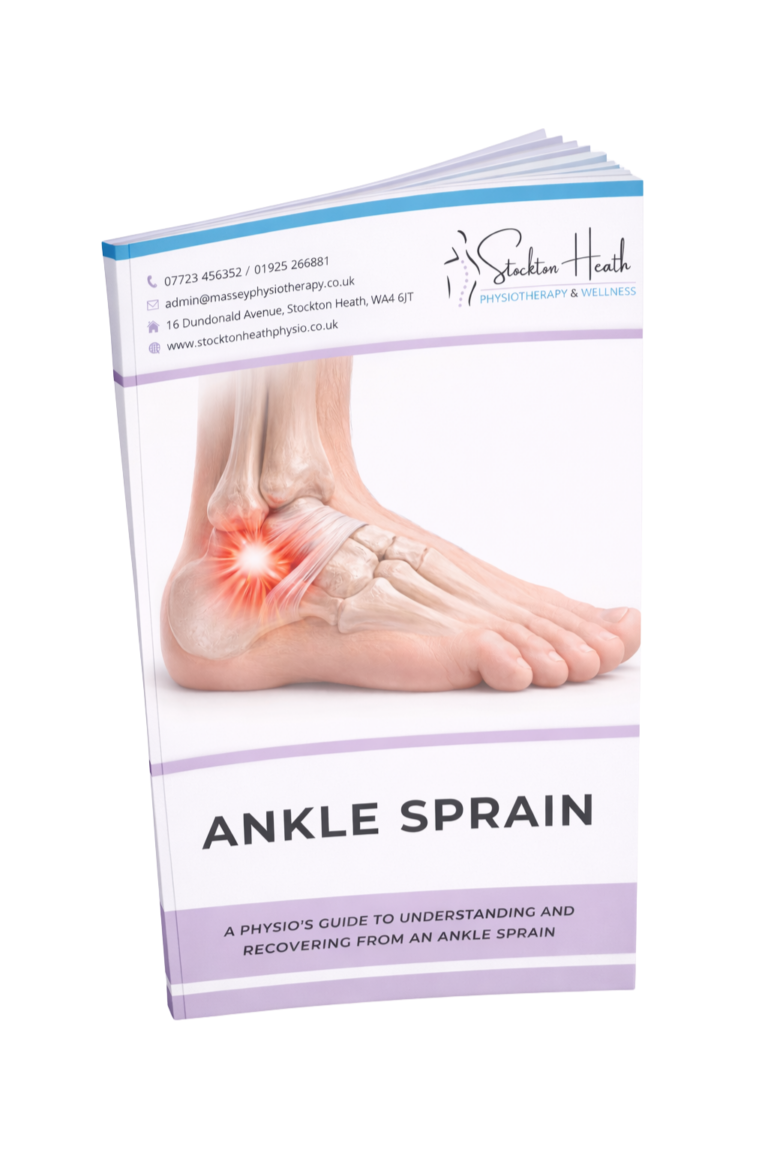
Want to start understanding and improving at home before you commit to an appointment? Download our free guide
Download your free guide
No spam, ever. Unsubscribe anytime.