
Struggling with a frozen shoulder in Warrington?
Frozen shoulder treatment in Warrington — earlier treatment, shorter recovery
If you're finding it difficult to:
- Move your shoulder freely without debilitating stiffness
- Sleep without shoulder pain waking you at night
- Get dressed, reach and drive without the shoulder dominating your day
You’re not alone — and you don’t have to just put up with it. Frozen shoulder — medically known as adhesive capsulitis — occurs when the capsule surrounding the shoulder joint becomes inflamed and thickened, causing progressive stiffness and pain. It typically develops in three stages: a painful inflammatory phase, a stiffening phase, and a thawing phase where movement gradually returns.
Good News
The good news
Most people with frozen shoulder regain good shoulder function — and physiotherapy can significantly shorten the process. The earlier treatment begins, the shorter and less severe the stiffening phase tends to be. Acupuncture and EMTT are both available at our clinic and can be highly effective for the painful inflammatory phase.
Symptoms
Does this sound like you?
Shoulder pain — often severe and worse at night
Gradual and progressive loss of shoulder movement
Difficulty lifting the arm above shoulder height
Pain and restriction when reaching behind the back
Stiffness when dressing, washing hair or fastening clothing
A sense that the shoulder is getting stiffer over weeks or months
If any of these sound familiar, a physiotherapy assessment will tell you exactly what’s happening — and what will help.
Why it persists
Why does frozen shoulder become a long-term problem?
Frozen shoulder takes time — but the right treatment at the right stage makes a significant difference. One of the most common reasons patients struggle is being treated the same way throughout all three stages, when the approach should change as the condition progresses. Aggressive mobilisation in the painful stage makes things worse; inadequate movement in the thawing stage slows recovery.
Who gets frozen shoulder?
- Adults aged 40–60
- Women more than men
- People with diabetes (significantly higher risk)
- Individuals after shoulder injury or surgery
- People with thyroid or metabolic conditions
Common causes
- Inflammation triggering the capsule to thicken and contract
- Previous shoulder injury or surgery
- Reduced shoulder movement for a sustained period
- Diabetes — a significant risk factor for frozen shoulder
- Hormonal or metabolic conditions
- In many cases the exact trigger is not identified
Self-help
Simple steps that may help
01
Keep the shoulder moving gently within comfortable limits
02
Avoid complete rest of the shoulder
03
Perform gentle mobility exercises daily
04
Use heat before movement and ice after if helpful
If symptoms persist beyond 2–3 weeks, physiotherapy assessment is recommended.
When to seek help
When should you get help?
- Shoulder pain or stiffness lasting more than 2–3 weeks
- Movement becoming progressively restricted
- Sleep being disturbed by pain
- Daily tasks becoming difficult
Early treatment = faster recovery. Most patients start to notice improvement within the first few sessions.
Red flags
Red flag symptoms
- Severe shoulder pain after injury
- Sudden inability to move the arm
- Significant swelling or redness in the shoulder
- Persistent numbness or weakness in the arm
These symptoms may require GP review to exclude other causes.
Treatment
How we treat frozen shoulder at SHPW
At our clinic in Stockton Heath, Warrington, we use evidence-based treatments tailored to your specific condition
Hands-on physiotherapy
Stage-specific joint mobilisation and manual therapy
Acupuncture
Particularly effective for the painful inflammatory stage
EMTT
For the inflammatory phase and persistent cases
Gentle mobility programme
Matched to the current stage of the condition
Strengthening exercises
Introduced as movement returns in the thawing phase
Start fixing your frozen shoulder today
If your symptoms have lasted more than 2–3 weeks, they’re unlikely to go away on their own. The sooner you start treatment, the faster you recover.
Full appointment
Full Physiotherapy Assessment
A detailed diagnosis and a personalised treatment plan, ready to start straight away.
Free, no obligation
Free 15-Minute Discovery Visit
A quick chat to understand your problem, answer your questions and point you in the right direction. No obligation.
or call 01925 266881 · Monday–Saturday · No GP referral needed
Ready to get this sorted? No GP referral needed.
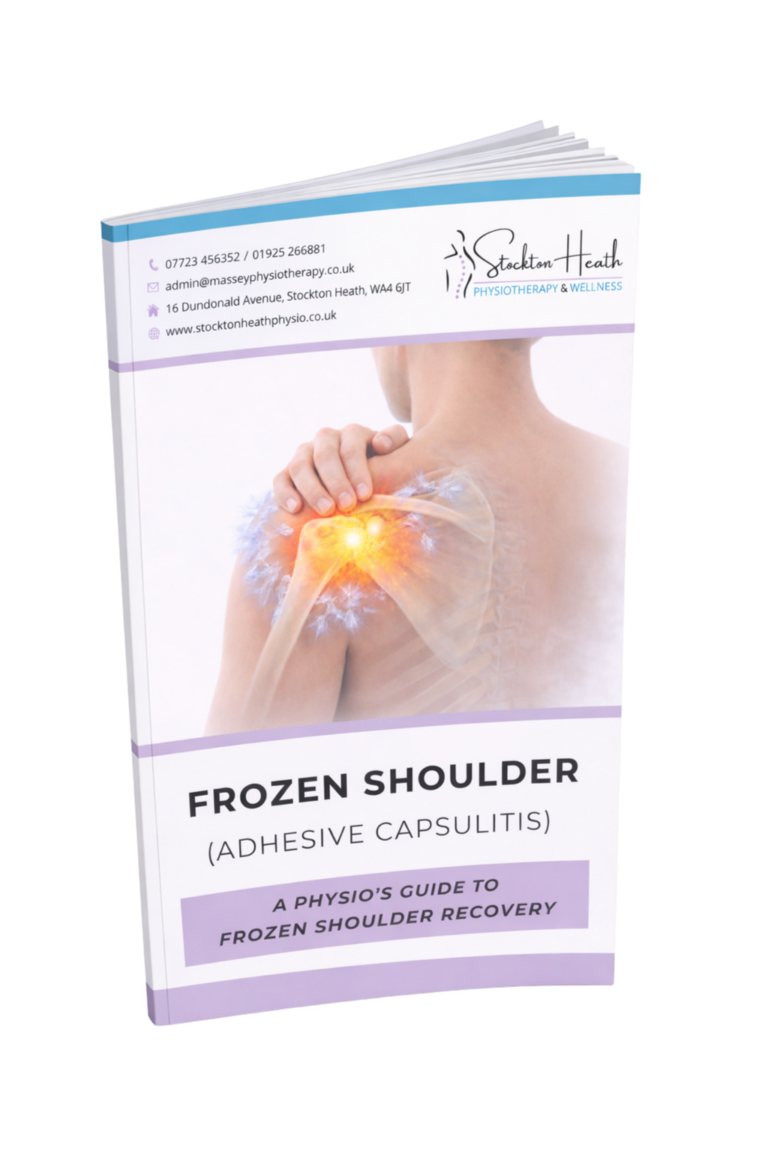
Free Guide
Not ready to book yet?
Want to start understanding and improving at home before you commit to an appointment? Download our free guide
Download your free guide
No spam, ever. Unsubscribe anytime.