
Struggling with shoulder weakness or rotator cuff pain in Warrington?
Rotator cuff pain in Warrington — specialist shoulder treatment
If you're finding it difficult to:
- Lift and reach without shoulder pain or weakness
- Sleep on the affected side again
- Get back to sport, work or daily activities without the shoulder holding you back
You’re not alone — and you don’t have to just put up with it. The rotator cuff is a group of four muscles and tendons that stabilise the shoulder joint and control arm movement. Rotator cuff pain occurs when these tendons become irritated, overloaded or partially torn — leading to pain, weakness and difficulty with overhead or behind-back movements.
Good News
The good news
Most cases of rotator cuff pain — including partial tears — improve significantly with physiotherapy and the right strengthening programme. Surgery is rarely necessary. Shockwave therapy is available at our clinic and is particularly effective for calcific tendinopathy within the rotator cuff.
Symptoms
Does this sound like you?
Pain in the shoulder or upper arm — often a deep ache
Pain when lifting the arm above shoulder height
Weakness when pushing, reaching or lifting
Pain when lying on the affected shoulder at night
Difficulty reaching behind the back
Shoulder that fatigues quickly with use
If any of these sound familiar, a physiotherapy assessment will tell you exactly what’s happening — and what will help.
Why it persists
Why does rotator cuff pain become a long-term problem?
Rotator cuff problems that don’t resolve are typically undertreated. Many patients are given a generic sheet of exercises that doesn’t address the specific tendon involved or the loading pattern that’s overloading it. Rotator cuff recovery requires progressive, structured loading — not generic shoulder exercises and not rest.
Who gets rotator cuff pain?
- Adults aged 40 and over
- Overhead sport athletes (swimmers, tennis, cricket)
- Manual workers performing repetitive overhead tasks
- People with poor shoulder posture
- Those returning to activity after a period of rest
Common causes
- Overload of the rotator cuff tendons from repetitive overhead activity
- Muscle imbalance reducing shoulder stability
- Poor posture placing sustained load on the tendons
- Sudden increase in activity or return to sport
- Previous shoulder injuries
- Calcium deposits forming within the tendons (calcific tendinopathy)
Self-help
Simple steps that may help
01
Temporarily avoid activities that specifically provoke the pain
02
Reduce repetitive overhead movements
03
Apply ice after activity
04
Begin gentle shoulder mobility to maintain range
If symptoms persist beyond 2–3 weeks, physiotherapy assessment is recommended.
When to seek help
When should you get help?
- Shoulder pain lasting more than 2–3 weeks
- Sleep being disturbed by pain
- Weakness developing or worsening
- Daily tasks like dressing becoming painful
Early treatment = faster recovery. Most patients start to notice improvement within the first few sessions.
Red flags
Red flag symptoms
- Severe shoulder pain after a fall or injury
- Sudden complete inability to lift the arm
- Significant swelling around the shoulder
- Persistent arm numbness or weakness
These symptoms may indicate a full rotator cuff tear and require GP review or imaging.
Treatment
How we treat rotator cuff pain at SHPW
At our clinic in Stockton Heath, Warrington, we use evidence-based treatments tailored to your specific condition
Hands-on physiotherapy
Manual therapy and targeted soft tissue work
Shockwave therapy
Clinically proven for calcific tendinopathy and chronic rotator cuff conditions
EMTT
For deep tendon repair and chronic shoulder conditions
Progressive strength programme
Structured loading to restore tendon and muscle capacity
Posture and movement coaching
Correcting the mechanics overloading the tendons
Start fixing your rotator cuff pain today
If your symptoms have lasted more than 2–3 weeks, they’re unlikely to go away on their own. The sooner you start treatment, the faster you recover.
Full appointment
Full Physiotherapy Assessment
A detailed diagnosis and a personalised treatment plan, ready to start straight away.
Free, no obligation
Free 15-Minute Discovery Visit
A quick chat to understand your problem, answer your questions and point you in the right direction. No obligation.
or call 01925 266881 · Monday–Saturday · No GP referral needed
Ready to get this sorted? No GP referral needed.
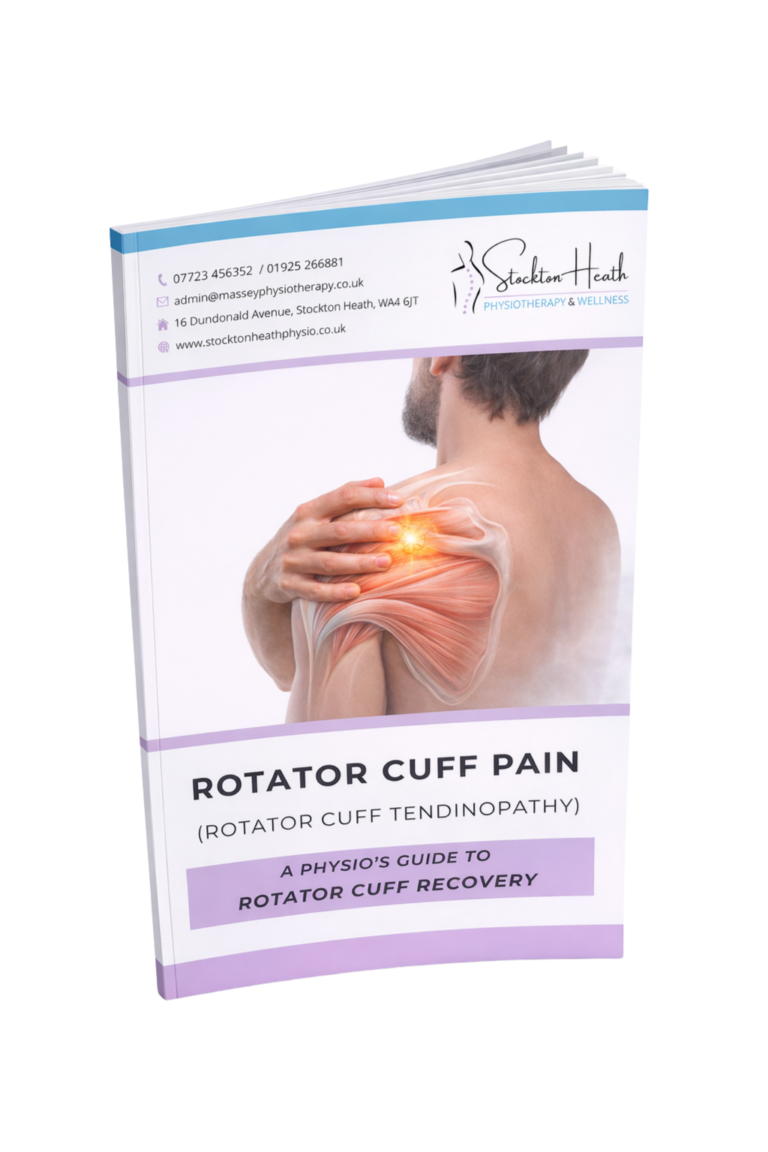
Free Guide
Not ready to book yet?
Want to start understanding and improving at home before you commit to an appointment? Download our free guide
Download your free guide
No spam, ever. Unsubscribe anytime.